What Is Model Distillation? A Beginner’s Playbook on Teaching a Small Model from a Big One
What is model distillation? Learn in plain words how a big AI teacher trains a small, cheaper student model, with six simple plays and clear tests.
Meera is a developer in Pune. She looks after the support inbox for a small online bookshop. Every morning a big AI model reads the new emails and sorts them: “late delivery”, “wrong book”, “refund”, “other”. It works well. But the monthly bill keeps climbing, and each email takes a few seconds to sort.
Her friend Arjun says, “Why not teach a small model to do just this one job, using the big model as its teacher?” Meera has never heard of this. So she asks the question many beginners ask: what is model distillation, and can a small model really learn from a big one?
This playbook follows Meera as she finds out. The story is hypothetical, and her numbers are illustrative. The steps are real.
Last verified: 28 November 2026. AI tools change fast; check the linked sources for anything newer.
Who this is for: beginners who already use an AI model in an app and want a smaller, cheaper or faster one for a single task. You should know what a prompt is. Time needed: about 30-45 minutes to read and plan your first run.
What is model distillation, in simple words
Think of a senior chef and a new cook. The chef knows hundreds of dishes. The new cook only needs to make the restaurant’s ten best sellers. So the chef cooks each dish many times while the cook watches, copies and practises. Soon the cook makes those ten dishes nearly as well, much faster and for a lower wage.
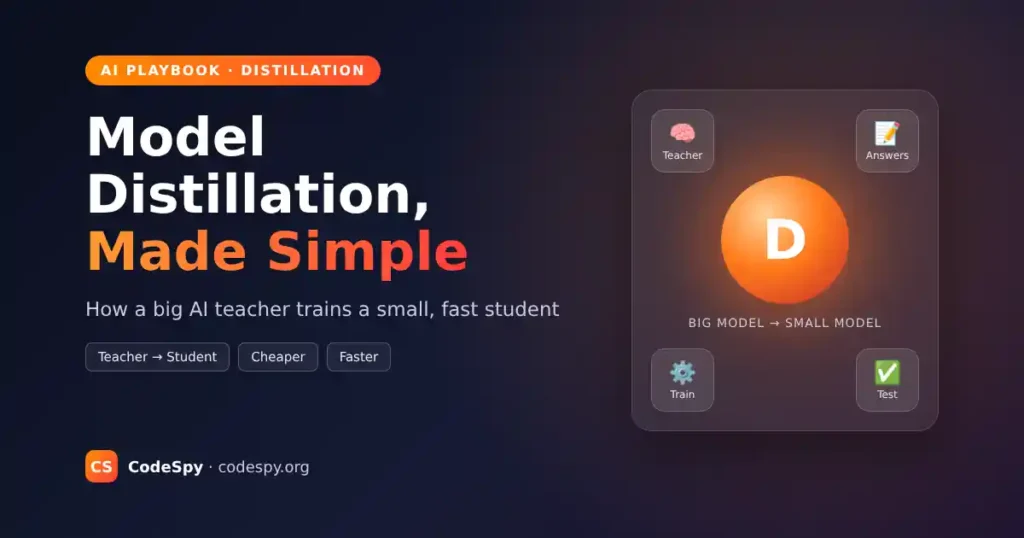
Model distillation works the same way. A large, capable model is the teacher. A smaller model is the student. The student is trained to copy the teacher’s answers for one kind of work. The precise version: knowledge distillation is a model compression technique where a smaller student model learns to imitate a larger teacher model, aiming for close-to-teacher quality with far fewer parameters (the numbers inside a model that hold what it has learned).
The idea is not new. It is usually traced to the 2015 paper “Distilling the Knowledge in a Neural Network” by Geoffrey Hinton and colleagues, which built on a 2006 “Model Compression” paper by Caruana and others.
Hard answers and soft answers
A teacher can share two kinds of answer. A hard target is just the final pick, like “refund”. A soft target is the teacher’s full set of chances, like “refund 70%, wrong book 25%, other 5%”. Soft targets carry more information, because they show which answers the teacher found close. IBM gives a nice example: an image model is far more likely to confuse a fox with a dog than with a sandwich.
Many hosted AI services only give you the text answer, not the chances. That is fine. Most beginner projects with large language models use the simpler form: collect the teacher’s written answers, then train the student on them.
The main kinds of distillation
- Response-based: the student copies the teacher’s final answers. This is the most common kind.
- Feature-based: the student copies what happens inside the teacher’s hidden layers. You need full access to the teacher’s internals.
- Chain-of-thought distillation: the student learns from the teacher’s step-by-step reasoning, not only its final answer.
The model distillation playbook at a glance
- Check that distillation is the right fix.
- Describe the one job and collect real prompts.
- Let the teacher answer, then review a sample.
- Pick a small student and train it.
- Test the student against the teacher.
- Ship it, watch it and retrain when things change.
Play 1: Check that distillation is the right fix
Goal: avoid weeks of work when a cheaper fix exists.
- Write down the problem in one line: too slow, too costly, or data must stay on your own servers.
- Check the task is narrow and stable, like sorting emails. The UK government’s AI guidance says distillation suits narrow, well-defined tasks; broad assistants still need big models.
- Try the cheap fixes first: a better prompt on a small model, or the tips in our LLM cost optimization playbook.
Meera tries a small model with a good prompt first. It gets about 78% of emails right (illustrative), while the big model gets 94%. That gap is the reason to distil.
You are done when: you can name one narrow task, the big model does it well, and a small model with a prompt does not.
Play 2: Describe the one job and collect real prompts
Goal: give the teacher the same kind of work the student will face.
- Write the job as a short instruction with the allowed answers.
- Gather real inputs. The UK guidance suggests a seed set of 2,000 to 5,000 prompts.
- Include the messy ones: typos, mixed languages, very short and very long messages.
- Remove personal details you do not need. If real data is thin, see our synthetic data playbook.
Meera exports 3,000 old support emails, removes names and phone numbers, and keeps a few Hinglish ones on purpose.
You are done when: you have a few thousand cleaned, realistic prompts in one file.
Play 3: Let the teacher answer, then review a sample
Goal: build a clean set of “question and good answer” pairs.
- Send every prompt to the teacher with the same instruction.
- Save each prompt and answer as one line in a file.
- Have a person review a sample. The UK guidance suggests about 10% of outputs.
- Fix or delete wrong answers. The student will copy mistakes too.
Here is the idea as a short illustration in Python. The ask_teacher function stands for whatever API call your provider uses.
import json

INSTRUCTION = "Sort this email into: late delivery, wrong book, refund, other."

with open("prompts.txt") as src, open("teacher_answers.jsonl", "w") as out:
    for email in src:
        answer = ask_teacher(INSTRUCTION, email.strip())  # your provider's API call
        row = {"prompt": email.strip(), "answer": answer}
        out.write(json.dumps(row) + "\n")
In plain steps: open the list of emails, ask the teacher about each one, and write the email and its answer as one line of a new file. That file becomes the student’s textbook.
Meera reviews 300 answers and finds 12 the teacher got wrong (illustrative). She fixes them before training.
You are done when: you have a reviewed answer file and you trust what is in it.
Play 4: Pick a small student and train it
Goal: teach the student from the teacher’s answers without overdoing it.
- Pick a student size. The UK guidance says 1 to 7 billion parameters is usually the best trade-off, and sub-billion models can be enough for simple tasks.
- Hold back 10% to 20% of the pairs as a validation set the student never trains on.
- Train with a light method such as LoRA, explained in our LoRA fine-tuning playbook.
- Stop early when the validation score stops improving. Plan for 2 or 3 rounds of fixing data and training again.
Meera picks an open model of about 3 billion parameters that runs on one GPU, and trains a LoRA adapter on her 2,500 training pairs.
You are done when: you have a trained student and its score on the held-back validation set.
Play 5: Test the student against the teacher
Goal: decide with numbers, not with a feeling.
- Use a fresh test set of real emails that neither model saw in training.
- Run the teacher, the student and the plain small model on the same set.
- Compare quality, time per answer and cost per thousand answers.
- Look at the student’s mistakes by category. Our AI evals playbook shows how to set this up.
Set expectations. The UK guidance says students typically keep 80% to 95% of the teacher’s task quality, and a specialised model can be 5 to 10 times faster. Meera’s student gets 90% right against the teacher’s 94% (illustrative), at a fraction of the cost.
You are done when: you have a small table with all three models and a clear pass mark the student meets or misses.
Play 6: Ship it, watch it and retrain when things change
Goal: keep the student good after launch day.
- Start with a small share of traffic and keep the teacher as a fallback for low-confidence cases.
- Log a sample of answers and check them each week.
- When your categories, policies or products change, repeat Plays 2 to 5. The student does not update itself.
Meera sends 20% of emails to the student for one week, checks 100 answers, then moves to 100%. When the shop adds an “e-book” category, she plans a retrain.
You are done when: the student handles live traffic, you check it on a schedule, and you know what triggers a retrain.
Do you need this?
| Option | Trade-off | Choose it when |
|---|---|---|
| Better prompt on a small model | Cheapest and fastest to try; may not be accurate enough | Always try this first |
| Quantization | Shrinks the same model; small quality loss | The model is good but too big for your machine |
| Fine-tuning on human labels | Needs labelled data you trust | You already have good labelled examples |
| Model distillation | Costs teacher calls and training time; student only knows one job | A big model does a narrow job well and you need it cheaper, faster or private |
| Keep the big model | Highest quality, highest cost | The task is broad or changes often |
Mistakes to avoid
- Distilling a broad assistant. A small student cannot hold everything a big model knows. Fix: pick one narrow job.
- Copying the teacher’s mistakes. The student learns errors and bias too. Fix: review a sample and test for bias before shipping.
- Testing on training data. The score looks great and means nothing. Fix: keep a separate test set of fresh real inputs.
- Ignoring the rules. Model licences and provider terms may limit using outputs to train other models. Fix: read the teacher’s terms of use before you start.
- Training once and forgetting. The task drifts. Fix: schedule checks and retrains.
How to know it is working
- The student beats the plain small model clearly on your test set.
- It meets the pass mark you set before training.
- Cost and time per answer drop as much as you hoped.
- Weekly spot checks stay at the same quality.
Your checklist
- ☐ One narrow task written in one line
- ☐ Cheap fixes tried first
- ☐ Teacher’s licence and terms of use checked
- ☐ A few thousand cleaned, realistic prompts
- ☐ Teacher answers saved and about 10% reviewed
- ☐ Validation set and separate test set held back
- ☐ Student compared with teacher and plain small model
- ☐ Gradual rollout, weekly checks and a retrain trigger
Frequently asked questions
What is model distillation compared with fine-tuning?
Distillation is a kind of fine-tuning where the training answers come from a teacher model instead of people. The training step can be the same, for example LoRA. The difference is where the “right answers” come from.
Is distillation the same as quantization?
No. Quantization stores the same model’s numbers with less precision, so it gets smaller. Distillation trains a different, smaller model to copy a bigger one. You can use both: distil first, then quantize the student.
How much data do I need?
The UK government’s guidance suggests a seed set of 2,000 to 5,000 prompts for a focused task. Start there, measure, and add more only if the test results ask for it.
Can the student become better than the teacher?
Rarely, and you should not expect it. The student is limited by the teacher behaviour it saw. Typical results keep 80% to 95% of the teacher’s quality on the task.
Can I run the student on my own computer?
Often, yes. Small students can run on a single GPU or even a laptop, which also keeps data in-house. Our run an LLM locally playbook shows how.
Back to Meera: a small model that knows one job well
A month later, Meera’s student sorts every support email in under a second. The big model now only sees the few emails the student is unsure about. The bill is much smaller, and she has a test set that tells her the moment quality slips.
So, what is model distillation? It is a big model teaching a small one a single job, followed by honest testing. Your next step: write your one narrow task in one line today, then pick the right size of model with our guide to choosing an AI model.
Sources: IBM, What is knowledge distillation? (soft and hard targets, types of distillation, history from Caruana 2006 and Hinton 2015); GOV.UK, AI Insights: Model Distillation (updated 3 August 2026; seed-set size, review share, student sizes and typical quality and speed ranges).